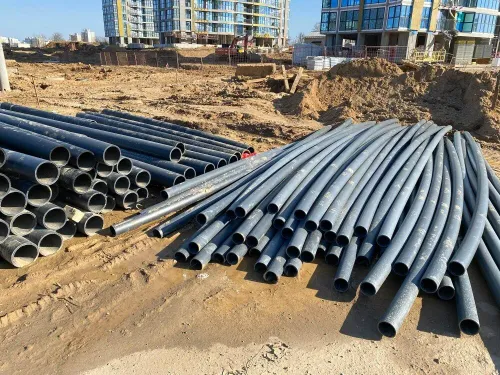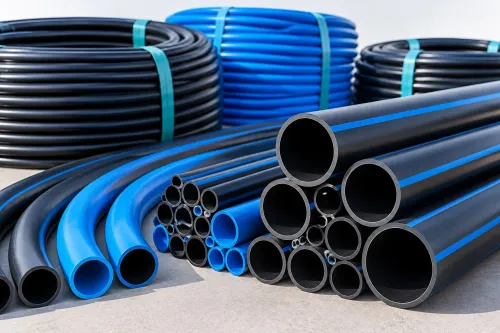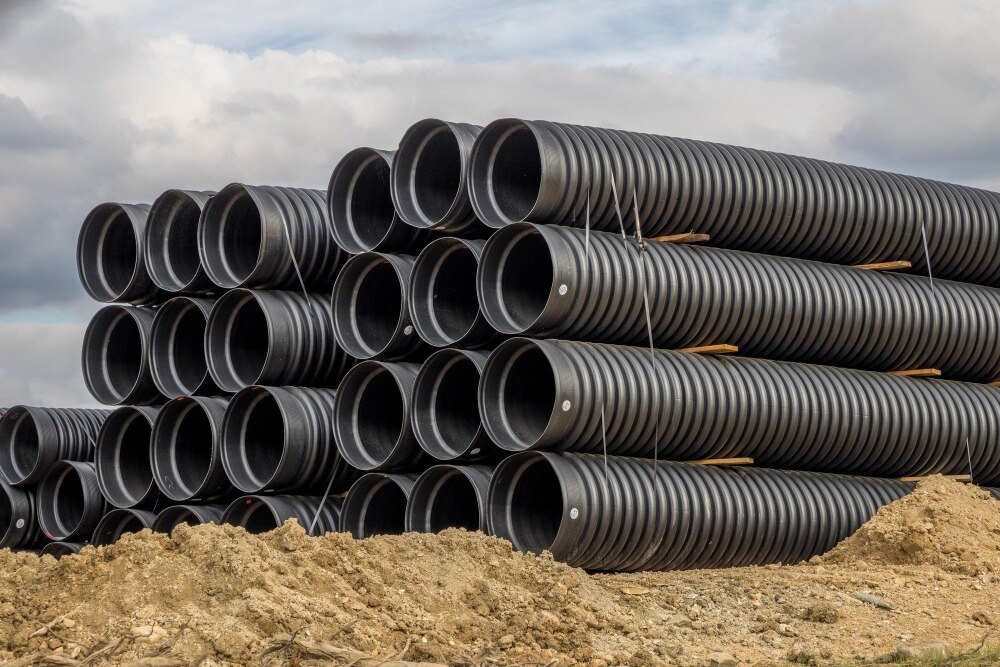
Choosing a sewage pipe for a trade project involves more than comparing outside diameters and quoted prices. You need to match the pipe construction, stiffness or pressure rating, joint system, installation method and manufacturer records to the actual wastewater and site conditions.
Key takeaways
- Match gravity, pressure and industrial wastewater duty before selecting pipe.
- Specify diameter, SDR, stiffness class and pressure rating separately.
- Control trench support, bedding, fusion and inspection before backfilling.
- Demand test reports, traceability records and installation guidance before award.
Which HDPE sewage pipe product is right for the service?
Identify the wastewater duty before comparing hdpe sewage pipe manufacturers: gravity sewer, pressure sewer and chemically demanding industrial wastewater require different evidence and product constructions.
| Application | Product and standard | Check before comparison |
|---|---|---|
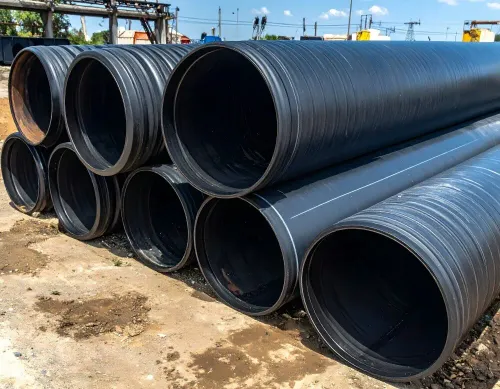
| Gravity sewer | Profile-wall pipe to ASTM F894 or corrugated/profile-wall pipe to ASTM F2306/F2306M | Confirm ring stiffness, wall profile, joint design, infiltration resistance and burial conditions |
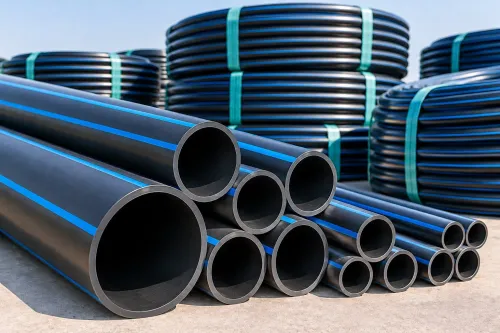
| Pressure sewer or rising main | Solid-wall pressure pipe to ASTM F714 or AWWA C906 | Confirm pressure class, surge allowance, temperature basis, fittings and fusion procedure |
| Chemically demanding wastewater | A pipe selected after reviewing the effluent | Confirm chemical concentration, temperature, exposure time, solvents, hydrocarbons and oxidizers |
Do not treat a manufacturer’s DWC drainage pipe, PLB telecom duct or drip-irrigation pipe as a sewage product. Its stiffness, pressure class, liner, perforation pattern, tolerances and joints may serve an entirely different duty.
For domestic sewage, HDPE sewage pipes offer corrosion resistance, flexibility and leak-resistant butt-fused or electrofused joints. Chemical resistance is not unlimited: hot industrial discharge, concentrated oxidizers, solvents and hydrocarbons can alter compatibility. Give the manufacturer the actual effluent composition and operating temperature, then request a written suitability statement tied to the quoted product standard.
A generic “chemical resistant” claim is not enough. A complete bid also identifies wall construction, applicable standard and test records for that exact product.
How should you specify diameter, SDR, stiffness and pressure rating?
State the service, applicable standard, pipe construction and design values—not only nominal diameter. For hdpe sewage pipes, include outside diameter, minimum wall thickness, internal hydraulic diameter, joint type, supplied length and the design flow or pressure.
| Service | Values to specify | Controlling design check |
|---|---|---|
| Gravity sewer | Nominal OD, internal diameter, wall or liner thickness, profile, ring-stiffness class and standard | Bedding, embedment, cover, groundwater, traffic and surcharge loads |
| Rising main | Nominal OD, SDR, minimum wall thickness, pressure class, design operating pressure and surge pressure | Internal pressure, temperature, fatigue, transient pressure and installation loads |
| Profile-wall gravity pipe | Inside hydraulic diameter, profile geometry, liner thickness, stiffness class, joint system and exact standard | Profile-specific stiffness and joint performance; do not compare by OD alone |
For solid-wall pipe, SDR is outside diameter divided by minimum wall thickness. A lower SDR gives a thicker wall, but SDR alone does not establish allowable pressure; resin strength, temperature, design coefficient, service life and the governing standard also control it.
Use ASTM F714 or AWWA C906 for solid-wall pressure pipe when that standard suits the project. Use the named gravity standard, such as ASTM F894 or ASTM F2306/F2306M, for profile-wall products.
Ask the manufacturer to identify the quoted standard, stiffness or pressure-test basis, resin batch, dimensional tolerances and installation limits. Do not accept DWC, telecom duct or irrigation pipe because its nominal diameter resembles a sewer pipe; its liner, stiffness, joints and pressure class may be unrelated.
How does HDPE compare with other sewer pipe materials?
HDPE offers lower total project effort when corrosion, ground movement, difficult access and infiltration control matter more than rigid-pipe stiffness. Its low weight reduces lifting and trench-handling work, while butt-fused or electrofused joints reduce leakage points and accommodate settlement. Fusion still requires trained crews, clean preparation and equipment.
| Material | Where HDPE usually reduces effort | Where the alternative can be better |
|---|---|---|
| Concrete | Lighter handling, fewer large lifting operations and better resistance to many wastewater chemicals | Large gravity sewers needing high inherent stiffness, shallow cover or heavy surcharge |
| Vitrified clay | Flexible installation and fewer joints across unstable ground | Smaller gravity lines where rigid, abrasion-resistant pipe and established local repair practices dominate |
| PVC | Better tolerance of settlement and longer fusion-welded joint continuity | Straightforward, low-temperature gravity networks where solventless push-fit joints and local availability minimise labour |
| Ductile iron | No internal corrosion allowance or extensive protective lining for many sewage services; lower handling weight | Rising mains requiring high pressure, impact strength, fire resistance or exposed above-ground restraint |
| GRP | Easier handling on constrained sites and fusion joints that reduce infiltration paths | Large-diameter, long straight installations where GRP’s stiffness-to-weight ratio and factory-made sections reduce joint count |
Check the quoted product family before comparing bids: solid-wall pressure pipe and profile-wall gravity pipe are not interchangeable. HDPE also expands about 1.2×10⁻⁴ per °C, can float in saturated ground, and needs movement or buoyancy controls. Vitrified clay, PVC or concrete may therefore demand less detailing in a stable, conventional gravity trench.
What installation and jointing controls protect a buried HDPE sewer?
Control groundwater, bearing, line and grade before placing HDPE sewage pipes. Dewater the trench, remove soft spots, and provide a level, stone-free bedding layer that supports the full pipe length. Check buoyancy where groundwater, flooding or open ends could lift an empty pipe; use temporary restraint or permanent anchoring at manholes, crossings and exposed ends.
- Match embedment material to the design: use specified granular surround, compact it evenly beneath the haunches, and prevent voids beside the springline.
- Keep fusion surfaces dry and clean. Butt fusion requires qualified operators, calibrated equipment, correct heater temperature, facing, alignment, joining pressure and cooling time.
- Record pipe batch numbers, joint numbers, weather, equipment settings and operator identification so a suspect joint can be traced.
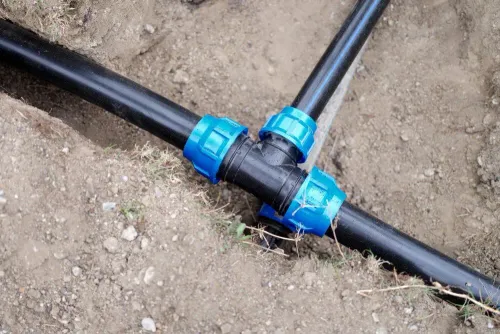
- For electrofusion or mechanical couplings, scrape oxidation where specified, control insertion depth, keep the joint immobile during cooling, and seat gaskets without twisting.
A bead that looks uniform does not prove fusion strength. Reject joints with contamination, misalignment, incomplete heating or movement during cooling, then complete the specified visual, pressure, air or water tests.
Place backfill in controlled lifts, compacting evenly on both sides rather than forcing the pipe sideways. Protect the crown from large stones and construction traffic until cover meets the design requirement; rushed backfilling causes deflection, settlement and infiltration paths at manholes and connections.
What should you demand from HDPE sewage pipe manufacturers before award?
Before award, require a submittal that identifies the quoted product standard and construction: ASTM F714 or AWWA C906 for solid-wall pressure pipe, or ASTM F894 and ASTM F2306/F2306M for profile-wall gravity pipe. Do not compare nominal diameter alone; demand inside hydraulic diameter, wall or liner thickness, stiffness class, pressure rating where applicable, and installation limits.
Request these records and commitments:
- Resin grade, compound approval, batch traceability, dimensional reports, and factory stiffness or pressure-test results.
- Certificates of conformity, product drawings, joint details, chemical-compatibility limits, and installation instructions matching the quoted standard.
- Fusion procedure, operator qualifications, calibration records, fusion logs, and sample-joint or destructive-test requirements.
- A complete fittings schedule covering bends, tees, reducers, stub ends, flanges, cleanouts, manhole connections, transition couplings, and electrofusion fittings.
- Field supervision for trial joints, fusion troubleshooting, inspection, testing, and repair instructions; define response time and who pays for attendance.
A supplier such as Harsh Agro Pipes And Fittings should be evaluated on whether its quotation covers these interfaces and records, not merely extruded pipe lengths.
| Quotation type | Evidence to demand | Likely consequence |
|---|---|---|
| Pipe-only price | Straight-pipe dimensions only | Missing fittings and site fabrication inflate installed cost |
| Complete system quotation | Fittings schedule, drawings, jointing method, test plan | Interfaces are priced and coordinated before award |
| Project-supported supply | Traceability, fusion records, site support, acceptance-test assistance | Defects are easier to locate before backfill |
Related product
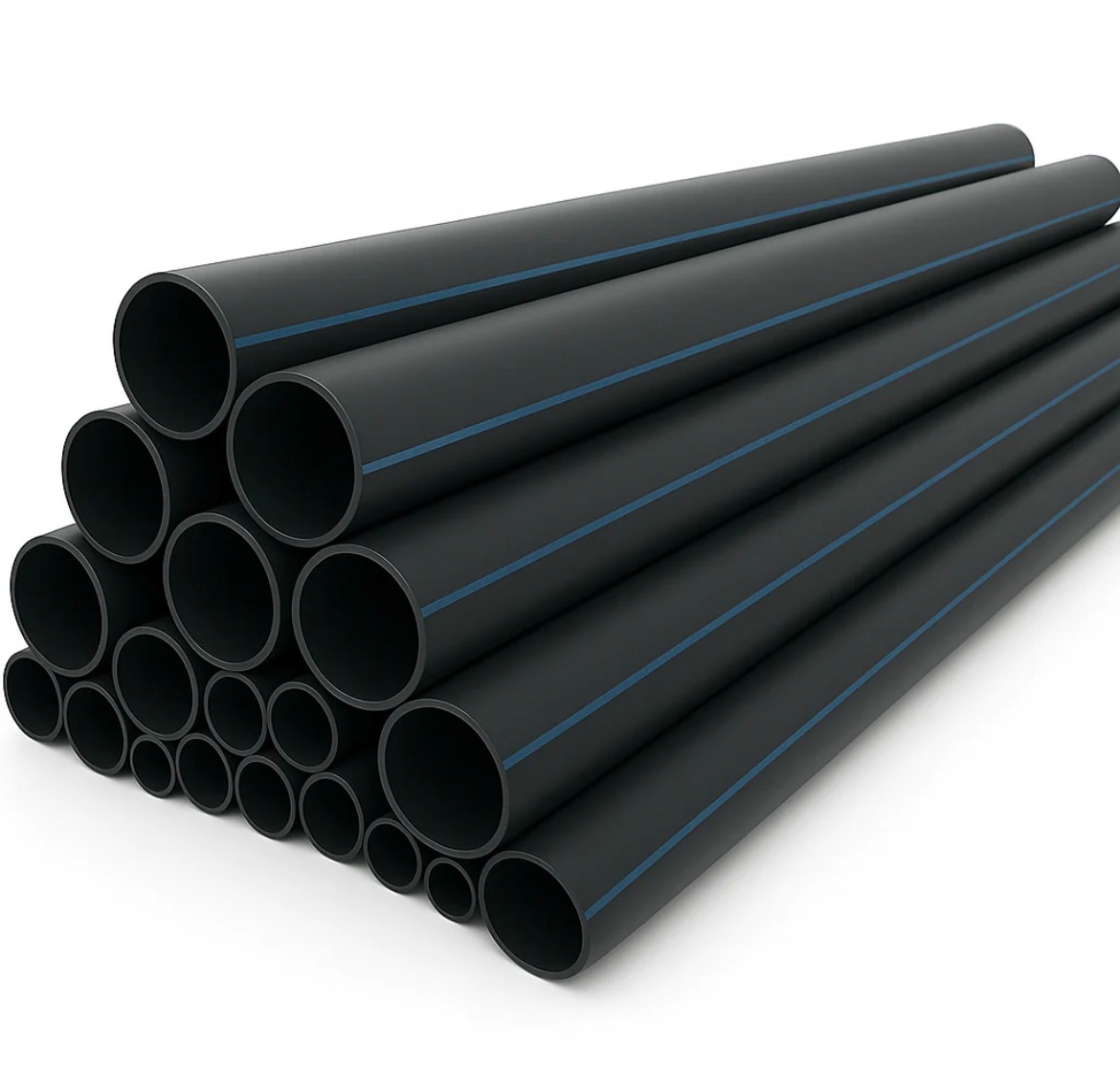 | HDPE Pipe Manufacturing Our HDPE pipes are manufactured using advanced, state-of-the-art technology to ensure superior strength, flexibility, and long-lasting performance. View product → |
Frequently asked questions
Which HDPE sewage pipe product is right for the service?
Use gravity-rated HDPE sewage pipes for non-pressurised flow, pressure-rated pipe for pumped sewers, and chemically compatible constructions for industrial wastewater. Confirm temperature, solids, abrasion and chemical exposure before selection.
How should you specify HDPE sewage pipes?
State nominal diameter, SDR, wall thickness, stiffness requirement, pressure rating where applicable, material grade, jointing method and required test documentation. Do not use SDR as a substitute for a confirmed structural or pressure design.
How does HDPE compare with other sewer pipe materials?
HDPE offers corrosion resistance, low weight and fused joints, while concrete, vitrified clay, PVC and ductile iron present different stiffness, chemical, handling and jointing trade-offs. Compare the complete installed system rather than pipe price alone.
What should you demand from HDPE sewage pipe manufacturers before award?
Request material and dimensional test reports, batch traceability, pressure or stiffness evidence, jointing procedures, installation limits, inspection records and warranty terms. Check that documents identify the exact pipe grade, SDR and production batch.
Keywords