A manufacturer’s claim that it supplies HDPE pipe tells you little about whether its material, dimensions, testing and joining support match your project. Before signing a purchase order, you need a specification-led check that connects the resin lot, production records and test evidence to the exact pipe being offered.
Key takeaways
- Confirm resin grade, batch number, standard and intended application before comparing prices.
- Fix outside diameter, wall thickness, pressure class, length and product-specific requirements in writing.
- Request production records, test reports, certificates and traceability for the supplied batch.
- Check that pipe, fittings, joining method and installation support are designed as one system.
Which resin, standard and application will govern the order?
Confirm the resin designation and governing standard before comparing quotations; “HDPE” alone does not define performance. Ask HDPE pipe manufacturers whether the pipe uses virgin resin, reprocessed material or a controlled blend, then request the resin manufacturer, grade, batch number, density, melt-flow rate, carbon-black content and dispersion result.
For black outdoor pipe, specify UV stabilisation and the carbon-black test method; “UV stabilized” is not evidence. For North American pressure pipe, request the ASTM D3350 cell classification and, where PE4710 is specified, a PPI TR-4 listing or equivalent compound evidence.
| Application | Standard to identify | Why it matters |
|---|---|---|
| Pressure water or sewer | ISO 4427, EN 12201, ASTM D3035 or ASTM F714 | Dimensions, tests, marking and pressure design differ |
| Potable water | The named water-pipe standard and approval | Drinking-water acceptance is separate from pipe strength |
| Industrial fluids | Project specification and chemical compatibility basis | Fluid chemistry and temperature govern suitability |
| Gas | The gas-pipe standard and approved resin designation | Gas service is not interchangeable with water service |
For hdpe pipe manufacturing requirements, state the resin designation, nominal diameter, SDR, pressure class and permitted application in the purchase order. Require design review for custom systems covering fluid chemistry, temperature, vacuum, surge and thermal expansion. A pipe suitable for sewerage is not automatically suitable for potable water, industrial fluid or gas.
What dimensions and product-specific properties must be fixed?
Nominal diameter is only a label, not an approval basis. Fix the dimensions, pressure class and tolerances against the governing standard, then require measurements from the actual production lot.
- Confirm outside diameter, minimum and average wall thickness, SDR, PN rating or design pressure, supplied length, ovality, straightness and every dimensional tolerance. Request a report showing local minimum wall thickness; an average can conceal a dangerously thin section.
For HDPE pipes for infrastructure projects, state whether lengths are straight or coiled and whether coil set will affect installation or fusion.
- Give DWC products a separate acceptance schedule rather than applying a solid-wall pressure-pipe standard alone. Define profile geometry, inner-bore diameter, ring stiffness or crush resistance, impact resistance, joint performance, perforation pattern and backfill conditions.
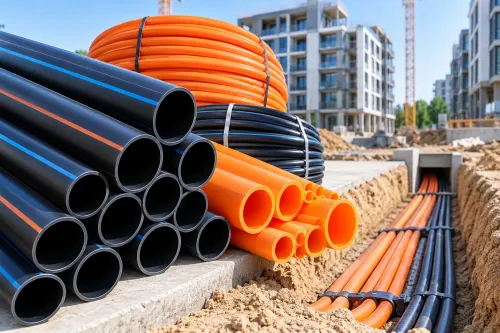
- For PLB telecom ducts, specify usable bore, minimum bend radius, ovality, friction, air-tightness for cable blowing, crush resistance, impact resistance, rodent or environmental protection, and whether construction is single-wall, multilayer or co-extruded. A reduced bore or oval duct can stop the specified mandrel or shorten blowing distance.
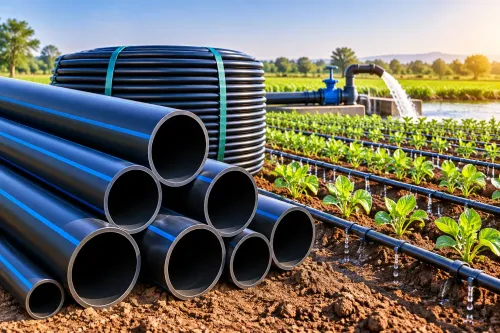
- Evaluate drip pipe as an emitter-and-pipe assembly. Request ISO 9261-based evidence for emitter flow at stated pressure, discharge uniformity, pressure-compensation behaviour, spacing, filtration sensitivity, wall thickness and operating-pressure limits.
- Include operating temperature, fluid chemistry, vacuum, burial or support conditions, thermal expansion, joining method and surge or transient loads in a custom design basis. Also request HDPE pipe production details showing coil or cut-length control and dimensional inspection records.
Can the factory make this size consistently and document the process?
Inspect the extrusion line, not a catalogue, to prove that the factory can make your size consistently.
1. Request the line’s diameter range and demonstrated output at your specified size. Review the die-change procedure, gravimetric dosing or blending controls, resin batch identification, and handling or drying controls where applicable. Ask for HDPE pipe production details: melt temperature, die pressure, haul-off speed, sizing method and cooling-bath conditions.
Confirm calibration sleeves or vacuum sizing maintain outside diameter, while online gauges continuously measure diameter and wall thickness.
2. Define the response to dimensional drift before placing the order. Identify who stops the line, how much material is quarantined, and how the affected batch is marked and traced. These are practical HDPE pipe manufacturing requirements because unstable extrusion can create local thin walls, ovality or surface defects that a short visual check misses.
3. Confirm whether the factory supplies straight lengths, coils or both. Check cut-length accuracy, coil winding, bend control, end caps and protection from dust, moisture and damage during storage and transport.
Examine marking on a representative pipe: it must reconcile the manufacturer, standard, material designation, diameter, SDR or pressure class, production date, line and batch number.
Request samples made on the same line, at the same size and from an identifiable production lot. A prototype, different diameter or untraceable sample proves nothing about your order.
Which tests, certificates and quality records prove conformity?
A certificate of conformity must name the product standard, resin designation, dimensions, SDR or PN rating, application and production lot. Do not accept a generic “HDPE” certificate from HDPE pipe manufacturers.
Match it to batch-specific test reports, inspection records and retained samples. Reconcile the resin lot, production date, extrusion line, dimensions, pipe marking and dispatched batch; a report for another diameter, prototype or resin batch proves nothing about your order.
| Evidence | What it must show | Failure it prevents |
|---|---|---|
| Hydrostatic-strength report | Standard temperature, stress, duration and acceptance criteria | A short burst test being mistaken for long-term pressure capability |
| Material and product tests | Tensile or elongation, reversion, oxidation-induction time, carbon-black content and dispersion, impact resistance | Unverified HDPE pipe manufacturing requirements |
| Joint tests | Results for the specified joining method | Passing pipe reports being used to qualify fittings |
| Calibration and inspection records | Current gauges, equipment checks and dimensional results | Unreliable measurements and hidden drift |
Request separate qualification evidence for electrofusion and injection-moulded fittings. For polyethylene butt-fusion fittings, ASTM D3261 may apply; pipe reports do not qualify fittings.
Audit incoming-resin records, nonconformance reports, corrective actions, retained-sample control and lot-release approval. ISO 9001 supports the audit but does not prove compliance with the pipe standard.
For critical applications, arrange independent or witnessed testing. Put sampling frequency and acceptance criteria in the contract, including tensile, reversion, oxidation-induction time, carbon-black, impact and joint tests when the specified standard requires them.
Will the pipe, joints and installation support work as one system?
Evaluate joining capability separately from extrusion quality: a pipe can pass factory tests and still fail at the joint. Compare hdpe pipe manufacturers on their ability to join the specified diameter, SDR and resin, not only on equipment or product samples.
1. Ask whether the manufacturer supports butt fusion, electrofusion and mechanical connections for your exact pipe specification. Require a qualified butt-fusion procedure, operator qualification, machine calibration, heater-plate temperature control, facing and alignment checks, bead-acceptance criteria, and fusion records.
2. Require each fusion record to identify outside diameter, wall thickness or SDR, resin, machine, heater temperature, pressure, heating and cooling times, operator and joining conditions. ASTM F2620 is a recognised reference for heat-fusion joining of polyethylene pipe and fittings.
3. Request separate qualification evidence for electrofusion fittings; pipe reports do not qualify fittings. Check that each fitting’s pressure rating, dimensions and SDR compatibility match the pipe, and request ASTM D3261 evidence where polyethylene butt-fusion fittings apply.
4. Confirm who supplies fusion parameters, site training, troubleshooting and post-installation inspection. Incorrect facing, contamination, misalignment or settings can produce a failed joint, including on hdpe pipes for infrastructure projects.
Ask Harsh Agro Pipes And Fittings to demonstrate the same traceable material evidence, product-specific testing and joining support required from every shortlisted supplier. Make the decision through a signed compliance matrix, representative samples, witnessed tests and a contract linking payment to identifiable, accepted production lots.
Related product
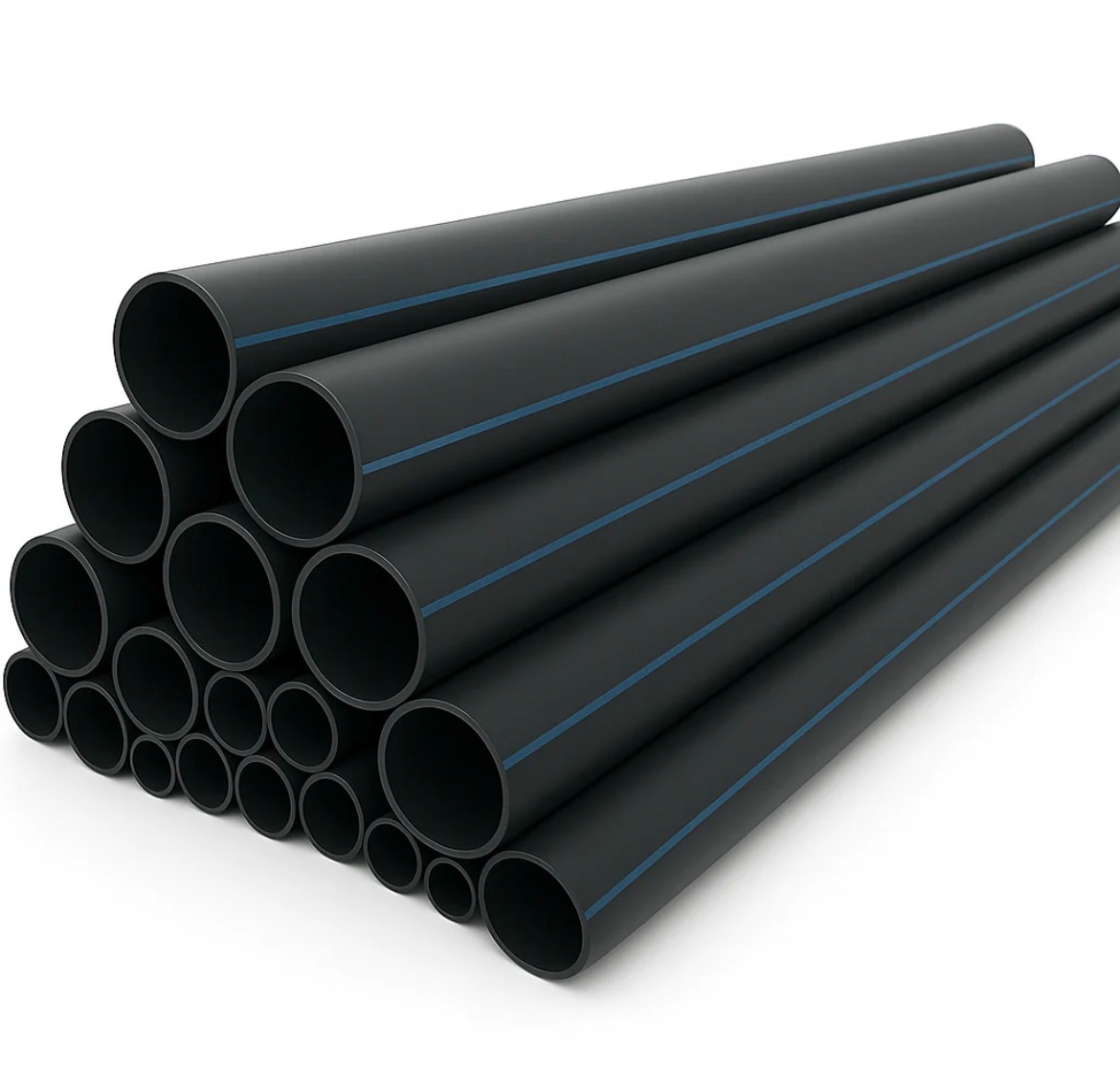 | HDPE Pipe Manufacturing Our HDPE pipes are manufactured using advanced, state-of-the-art technology to ensure superior strength, flexibility, and long-lasting performance. View product → |
Frequently asked questions
Which resin, standard and application should govern an HDPE pipe order?
Define the resin type and grade, virgin or controlled blend status, governing standard, and intended use before requesting quotations. Ask for the resin manufacturer, batch number, density, melt-flow rate, carbon-black content and dispersion result.
What pipe dimensions and properties must be fixed before ordering?
Specify outside diameter, wall thickness or SDR, pressure class, pipe length, colour, coil or straight-length format, temperature conditions and any application-specific properties such as chemical resistance or flexibility.
How can you confirm a factory can make the selected pipe consistently?
Ask for the manufacturing range, extrusion line capability, dimensional-control records, process checks, calibration records and batch traceability. Confirm that the factory can maintain the required dimensions across the full order, not only produce a sample.
Which tests and records prove HDPE pipe conformity?
Request the applicable standard, test plan, laboratory reports, dimensional inspection results, hydrostatic or pressure-test records, carbon-black dispersion results, resin certificates and a certificate of conformity linked to the batch.
How do you ensure the pipe, joints and installation support work together?
Match the pipe material and dimensions with compatible fittings and joining equipment. Confirm butt-fusion or electrofusion procedures, operator qualifications, site testing, repair instructions and installation guidance before delivery.
Keywords