An industrial pipeline must be matched to its fluid, pressure, temperature, installation environment and jointing method; nominal diameter alone cannot prove that a pipe will perform. By the end, you will be able to define the design inputs, compare materials, verify hydraulic and structural suitability, and challenge a quotation before procurement.
Key takeaways
- Match resin, pressure rating and wall thickness to the fluid and operating conditions.
- Check hydraulic capacity, surge pressure, temperature limits and external loads before selection.
- Use qualified butt fusion or electrofusion procedures, then document inspection and pressure testing.
- Demand resin data, dimensional records, joint procedures and test certificates with every quotation.
What makes an HDPE pipe suitable for industrial infrastructure?
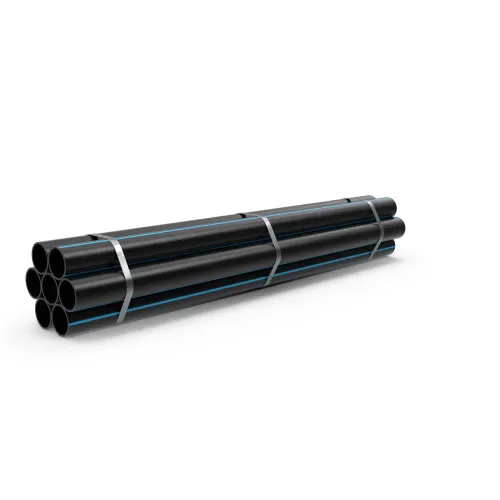
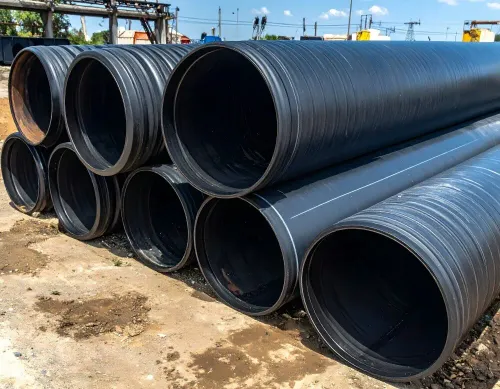
An HDPE industrial pipe is an engineered system, not a generic plastic tube. Its suitability depends on resin grade, wall design, joints, fluid, temperature, pressure, burial conditions and repair strategy. Solid-wall pressure pipe differs from ordinary water-supply HDPE because industrial hdpe pipe applications demand verified chemical compatibility, surge resistance and external-load performance.
| Material | Flexibility, corrosion and installation | Limitations |
|---|---|---|
| HDPE | Flexible, lightweight, corrosion-resistant and fusion-jointed; leaks are fewer at continuous fused joints | Temperature derating, fire vulnerability and specialised repairs |
| PVC | Light, corrosion-resistant and stiff | Brittle impact behaviour, less tolerance of bending and temperature |
| Steel or ductile iron | High stiffness and external-load capacity | Heavy, corrosion protection, lifting equipment and bolted or welded repairs |
| Concrete | Strong under compression and suitable for gravity systems | Heavy, rigid, difficult to repair, and vulnerable to cracking or joint infiltration |
Different products solve different problems:
- Pressure pipe carries pressurised water, chemicals, slurry or wastewater.
- Telecom conduit protects cables; hdpe pipes for telecom projects need the correct bore, bend radius, crush resistance, pulling tension and cable-installation friction.
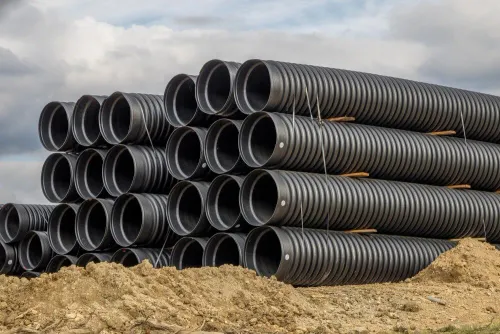
- DWC pipe serves gravity drainage, with profile stiffness and embedment controlling performance.
- Drip tubing depends on emitter spacing, filtration and discharge uniformity.
PE80 and PE100 identify material strength classes. Ratings use MRS under ISO practice or HDB/HDS in North America. SDR equals outside diameter divided by minimum wall thickness; PN states nominal pressure class. Confirm temperature derating and the governing design coefficient: nominal diameter and SDR alone do not fully specify the product.
A water pressure pipe can fail as a telecom duct if its bore, ovality, reel handling or air-blowing characteristics are wrong.
Which HDPE industrial pipe requirements determine the specification?
The conveyed fluid and the loads around the line determine the specification, not the label HDPE. Record concentration, solids or slurry content, flow rate, operating and surge pressure, minimum and maximum temperature, pipe diameter, required service life, and installation method. These are the core HDPE industrial pipe requirements.
SDR equals outside diameter divided by minimum wall thickness. For the same material rating, a lower SDR generally provides greater pressure capacity, but confirm the rating at the actual operating temperature using the governing design coefficient and qualified material basis.
| Service | Review before approval | Failure if ignored |
|---|---|---|
| Acids and alkalis | Concentration, temperature and exposure time | Chemical attack or premature loss of strength |
| Hydrocarbons and solvents | Compatibility, permeation and nearby materials | Contamination or damage outside the pipe |
| Wastewater and slurries | Solids size, concentration, velocity and abrasion | Sedimentation, erosion or blockage |
For HDPE industrial pipes, require a compatibility table or project-specific review rather than assuming every fluid is suitable. For buried lines, record these installation inputs:
- Trench width, haunching quality, embedment and native-soil stiffness
- Groundwater, cover depth, traffic loading and construction surcharge
- Long-term deflection limits and inspection method
Soil-pipe interaction can govern the design even when internal pressure is low. A pressure class alone does not specify a safe buried installation.
How do hydraulics, temperature and exposure change pipe selection?
Verify the bore before choosing a nominal size: internal diameter is approximately outside diameter minus twice the wall thickness, but calculate a range using outside-diameter and minimum-wall tolerances. Then calculate flow velocity, frictional head loss, fittings and elevation change; check pump duty and surge pressure instead of selecting by diameter alone.
HDPE moves about 0.12 mm per metre per °C. Above-ground lines therefore need expansion loops, guides, anchors or a movement-tolerant layout; installation temperature determines the movement left to accommodate. Buried pipe gains restraint from soil friction, while above-ground pipe needs engineered supports.
| Condition | Main design check | Typical consequence |
|---|---|---|
| Buried line | Soil friction, cover, temperature at installation | Movement is restrained, but thermal stress can transfer into joints and anchors |
| Above-ground line | Expansion, guides, anchors and support spacing | Unmanaged movement can bend fittings or pull transitions apart |
| Exposed industrial line | Temperature, ultraviolet radiation and fire separation | Apply temperature pressure derating; specify UV-stable material, ventilation and separation where fire or smoke is a concern |
For industrial HDPE pipe applications, confirm PE80 or PE100 hydrostatic rating, SDR, design coefficient and temperature derating at the actual service temperature. UV stabilisation does not make polyethylene non-combustible; follow the project’s fire, ventilation and separation requirements.
HDPE pipes for telecom projects require more than pressure capacity. Specify bore smoothness, ovality, bend radius, crush and impact resistance, pulling tension, friction, cable clearance and air leakage.
Check route geometry, bend count, duct length and chambers for cable pulling or air-blown fibre; a larger duct or shorter sections can prevent excessive pulling or blowing force.
How should industrial HDPE pipes be joined, installed and tested?
Choose the joint for site access, pipe diameter, repair strategy and the equipment it must connect to, not for price alone. These choices belong in the hdpe industrial pipe requirements before delivery.
| Method | Access and diameter | Repair and disassembly | Best connection use |
|---|---|---|---|
| Butt fusion | Open access; broad diameter range | Permanent; cut out a section to repair | Continuous HDPE runs |
| Electrofusion | Tight access; fittings limit diameter | Localised repair; not normally disassembled | Repairs, tie-ins and congested trenches |
| Flange adaptor | Requires bolt access and alignment | Easily disassembled | Pumps, valves and metallic equipment |
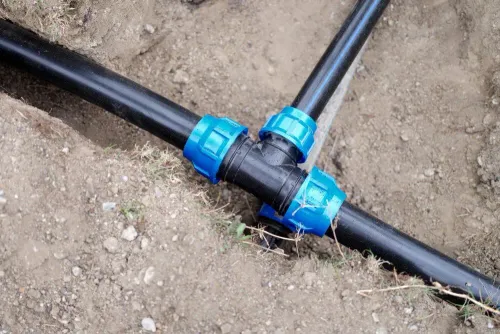
| Mechanical coupling | Useful where fusion equipment cannot fit | Removable; plan restraint | Repairs and short tie-ins |
| Transition fitting | Access depends on the metal side | Disassembly follows the metal connection | HDPE-to-steel, ductile iron or threaded equipment |
A fused joint is not automatically as strong as the parent pipe. Use a qualified procedure, square and aligned ends, clean surfaces, controlled heater temperature, the specified melt bead and interface pressure, then hold the joint motionless through cooling. Contamination, misalignment, over-scraping, a weak bead and early movement create defects.
Use restrained transition fittings where pressure thrust could separate the connection. Inspect gasket faces and gaskets for cuts, debris and correct seating; align flanges without forcing the pipe, then tighten bolts in a cross-pattern. Include removable sections so damaged hdpe industrial pipes can be isolated and replaced.
- Test completed lines under ASTM F2164.
- Stabilise pressure before the hold period; follow the specified temperature, duration and allowable make-up water.
- Account for polyethylene’s viscoelastic expansion: a pressure drop alone does not prove leakage.
What evidence should you demand in an HDPE pipe quotation?
“HDPE pipe” is not enough for a comparable quotation. Use this checklist for HDPE industrial pipe requirements and custom systems:
1. Require resin designation, PE80 or PE100 grade, MFR or MFI, outside diameter, minimum wall thickness, SDR, PN or another stated pressure basis, operating-temperature range, and required service life. Identify the governing standard: IS 4984, ISO 4427 or EN 12201.
2. Require dimensional tolerances, colour, UV requirements, chemical service and concentration, and the design temperature. Ask for the batch number, traceability records, material and hydrostatic test certificates, inspection records, and the exact pipe marking.
3. Require the jointing procedure, fusion or coupling controls, operator qualification requirements, warranty exclusions and replacement terms. A quotation that omits test evidence leaves you unable to verify whether the supplied pipe matches the specification.
4. For HDPE pipes for telecom projects, specify internal bore, bore smoothness, minimum bend radius, ovality, crush and impact limits, allowable pulling tension, blowing limits, cable or microduct compatibility, and whether installation uses pulling or compressed air. Do not substitute DWC drainage pipe or drip tubing for a solid-wall pressure line.
Harsh Agro Pipes And Fittings can help coordinate custom dimensions with matching fittings, but base the purchase on documented compliance, batch traceability and test results—not a nominal diameter or product label alone.
Related product
 | HDPE Pipe Manufacturing Our HDPE pipes are manufactured using advanced, state-of-the-art technology to ensure superior strength, flexibility, and long-lasting performance. View product → |
Frequently asked questions
What makes an HDPE pipe suitable for industrial infrastructure?
Suitability depends on resin grade, wall design, chemical compatibility, pressure and surge resistance, joint integrity, burial conditions and repair requirements.
Which HDPE industrial pipe requirements determine the specification?
Specify the fluid, flow rate, operating and surge pressure, temperature, installation method, external loads, diameter, wall thickness and applicable testing requirements.
How do hydraulics, temperature and exposure change HDPE pipe selection?
Flow requirements determine diameter and pressure loss; temperature affects pressure capacity; ultraviolet exposure, chemicals, abrasion and soil loads affect material and installation choices.
How should industrial HDPE pipes be joined, installed and tested?
Use approved butt fusion or electrofusion procedures, control alignment and cleanliness, inspect joints, protect the pipe during placement, and complete documented pressure testing.
What evidence should you demand in an HDPE pipe quotation?
Request resin-grade details, dimensional data, pressure and SDR information, chemical-compatibility evidence, fusion procedures, quality records, test certificates and delivery traceability.
Keywords