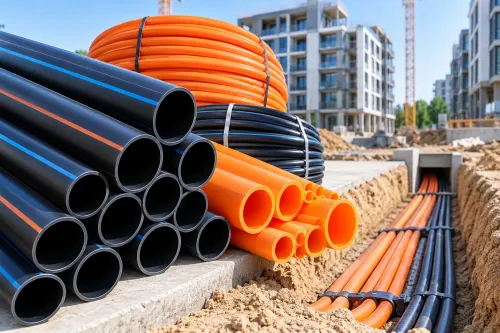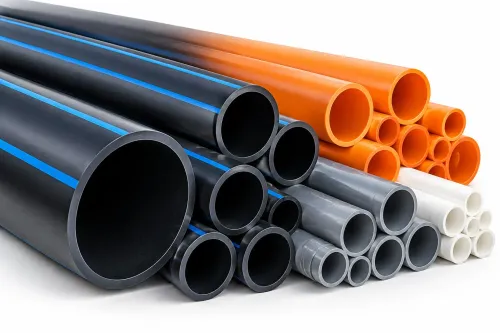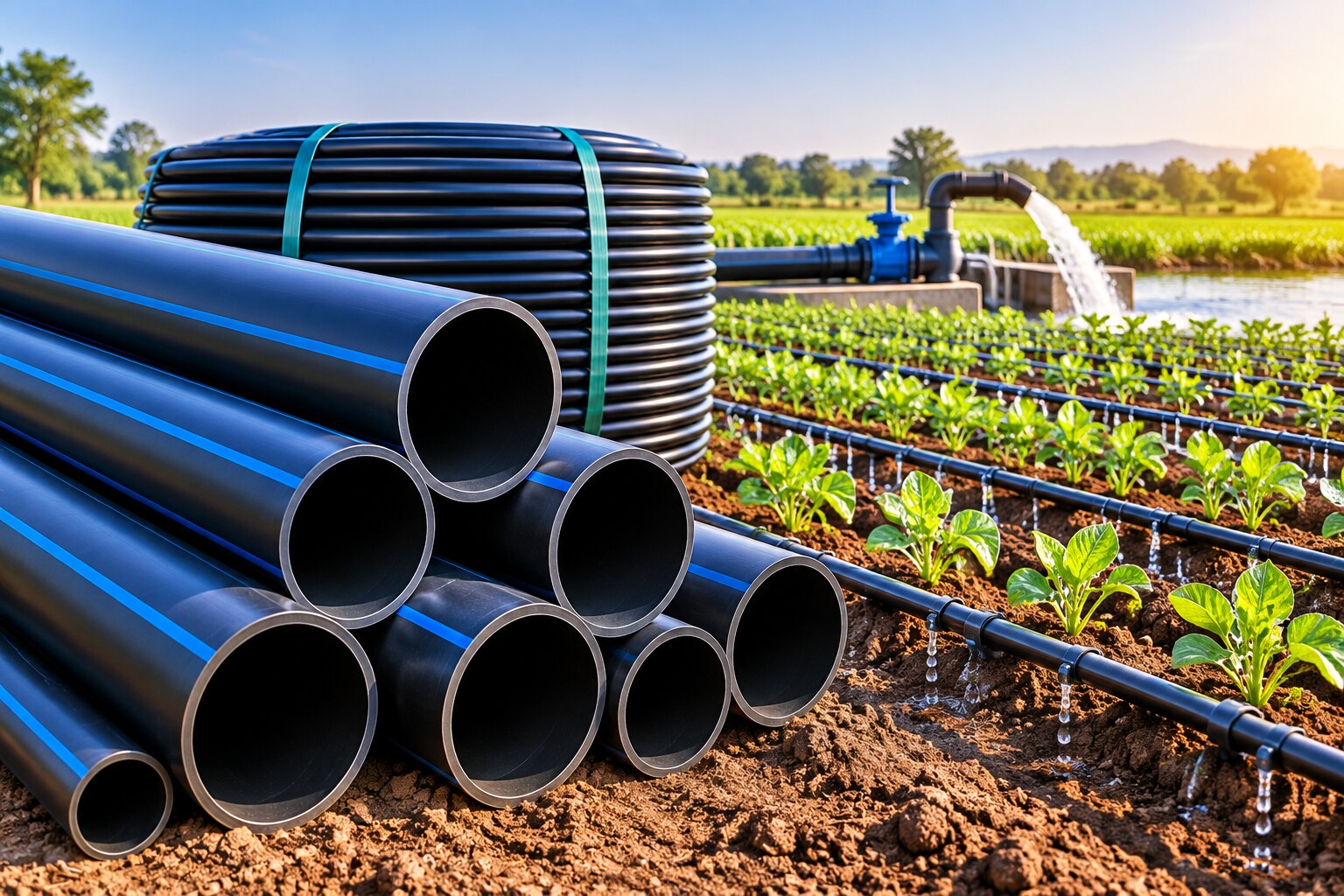
An agricultural pipe is not defined by its colour or nominal diameter alone: resin grade, wall thickness, forming method, emitter design, and testing determine whether it will survive a buried main, an exposed field run, or a drip system. By following each production stage and the documents behind it, you can compare pipe quotations, identify weak specifications, and match the construction to your farm project.
Key takeaways
- HDPE suits stronger pressure lines; LDPE suits flexible pipes and drip products.
- Extrusion controls resin temperature, wall thickness, cooling, sizing, and pipe length.
- Driplines require emitter spacing, flow-rate, filtration, and clogging checks.
- Match pipe diameter and pressure rating to pump output, terrain, and field layout.
Which raw materials enter an agricultural pipe factory?
Polyethylene is the main raw material: HDPE for stronger pressure lines and LDPE for flexible agricultural pipes and drip products. The manufacturer selects a grade with the required density and melt-flow range, then feeds clean, dry resin into extrusion equipment.
Drying depends on the compound and supplier instructions; heating every resin by habit can damage it.
Before production, the material plan should identify:
- Controlled in-house rework from the same traceable production stream
- Colour masterbatch, carbon black, UV stabilisers, antioxidants, lubricants, and other processing additives
- Clean, dry storage that prevents dust, moisture, and cross-contamination
- Unidentified recycled plastic as a risk because it can alter melt flow, contamination, oxidation resistance, and long-term pressure performance
| Material choice | What it means | Buyer check |
|---|---|---|
| HDPE | Stiffer, stronger pressure-pipe compound | Grade, density, melt flow, and standard |
| LDPE | More flexible compound for low-pressure or drip applications | Declared application and flow range |
| Black compound | Carbon black plus stabilisers for outdoor exposure | Carbon-black content, dispersion, and traceability |
| Reworked resin | Controlled factory scrap returned to production | Standard allowance and source records |
A black surface proves colour, not UV resistance. Ask for the applicable product standard, carbon-black content and dispersion evidence, compound traceability, and a certificate of analysis showing resin grade, batch, melt flow, density, and additive status.
A batch code should connect that resin lot to the finished coil, whether you compare agricultural pipes in Pune or an agricultural pipe manufacturer in Maharashtra.
How continuous extrusion turns resin into a pipe
The irrigation pipe manufacturing process for solid-wall HDPE and LDPE pipe is continuous: resin is metered, melted, formed, sized, cooled, marked, and finished without stopping the line.
1. A gravimetric or volumetric feeder meters resin and additives into a single-screw extruder. Inside the heated barrel, the screw melts and homogenises the polymer while melt-pressure controls monitor stable output.
2. The melt passes through a screen pack, which removes contaminants, then enters an annular die head. The die opens the melt into a continuous tube; its gap influences the initial wall thickness.
3. The tube enters a vacuum-sizing tank. Controlled vacuum draws the hot tube against a sizing sleeve, establishing the outside diameter and limiting ovality.
4. A cooling tank sprays or immerses the tube in water. Cooling temperature and residence time fix the shape; insufficient cooling lets the pipe deform after sizing.
5. A haul-off pulls the pipe at a controlled line speed. Extrusion output and haul-off speed jointly determine wall thickness and mass per metre: more output adds material, while faster pulling makes the wall thinner.
6. A printer applies size, material, pressure class, batch code, and production details. A cutter makes specified lengths, while a coiler winds flexible pipe into rolls; cut lengths and coiled pipe need different length and tension checks.
7. Inspectors check diameter, wall thickness, ovality, and coil tension. Excessive tension can flatten the pipe, while inconsistent speed or cooling creates dimensional variation.
DWC products use different machinery. A corrugator forms an annular profile around an inner wall, so corrugated DWC production is not ordinary smooth-wall extrusion.
How dripline differs from plain water-transfer pipe
A plain transfer pipe carries water continuously; a dripline meters it through discrete emitter units. Each emitter is moulded with an inlet filter and a narrow labyrinth flow path, then attached to or inserted into the tube at a specified spacing.
Round dripline and drip tape are made differently.
| Option | Construction | Effect |
|---|---|---|
| Round dripline | A circular tube is extruded while emitters are positioned or inserted inline | Uses barbed or compression fittings and tolerates more pressure than thin tape |
| Drip tape | A flat strip is formed, the emitter passage is created, and the longitudinal seam is heat-sealed | Needs tape connectors and careful handling at the sealed seam |
Pressure-compensating emitters use a flexible diaphragm to hold discharge near a set rate as pressure changes. Non-pressure-compensating emitters rely on labyrinth dimensions, so discharge rises and falls more directly with pressure.
Line speed controls how accurately the emitter unit reaches its spacing target. Placement error, passage dimensions, and the specified test pressure change discharge and the coefficient of manufacturing variation.
Drip-product checks include:
- Online camera inspection of the perforation or emitter unit
- Spacing and roll-length checks
- Flow tests at the declared pressure
- Clogging-resistance evaluation
The factory test uses clean water, not every farm’s water. A blocked filter, poor flushing, mineral deposits, or biological growth can reduce field discharge after a passing result. Match filtration to the emitter inlet and water analysis.
A search for agricultural pipes irrigation pipe manufacturers in Pune should therefore compare emitter data and test records, not pipe diameter alone. Thin-wall dripline is not joined like a thick-wall HDPE main.
How manufacturers verify dimensions, pressure, flow, and traceability
A production inspection checklist must connect the quoted pipe to measured evidence, not just a nominal diameter. An agricultural pipe manufacturer in Maharashtra should document these checks during the irrigation pipe manufacturing process:
1. Set the outside diameter at the sizing tank and monitor it continuously. Verify minimum and average wall thickness, ovality, nominal size, mass per metre, roll length, and declared tolerances at scheduled intervals. SDR equals outside diameter divided by wall thickness; a lower SDR means a thicker wall and normally higher pressure capability.
2. For PE100 pressure pipe at 20°C, compare the declared class with the design basis: SDR11 is approximately PN16, SDR17 PN10, and SDR26 PN6.3. Allowable pressure falls as irrigation-water temperature rises, so do not apply these values unchanged to hot water.
3. Inspect the surface for gels, black spots, scorched material, pits, and dimensional instability. Use hydrostatic-strength testing under ISO 1167 and long-term pressure assessment under ISO 9080; a short burst test alone cannot prove service life. Add leakage, tensile, or crush checks where the specification requires them.
4. For dripline, verify emitter spacing, discharge at the specified test pressure, coefficient of manufacturing variation, and clogging resistance. Factory flow results do not overcome poor filtration, biological growth, or mineral deposits in the field.
5. Request the applicable BIS or ISO specification, resin certificate of analysis, test report, inspection record, batch number, and traceability from resin lot to finished coil. Confirm that printed identification matches the delivered roll.
How to match manufactured pipe to the farm installation
Choose the pipe for the duty, not the material name. A flexible line feeding sprinklers needs different properties from a buried main or a row of emitters.
| Option | Flexibility and pressure | Joining, exposure and service |
|---|---|---|
| Smooth-wall PE | Flexible; select wall thickness for pressure | Compression fittings; bury or protect from sunlight; easy section repair |
| PVC pipe | Rigid; good pressure stability | Solvent-cement joints; needs careful bedding; sunlight and impact shorten service life |
| Lay-flat hose | Very flexible; lower pressure and abrasion tolerance | Quick couplings; above-ground seasonal use; punctures are easy to repair |
| Rigid HDPE main | Flexible during installation; thick-wall grades handle high pressure | Butt fusion or electrofusion; suitable for burial and long service; allow thermal movement |
| Micro-irrigation tubing | Flexible, low-pressure distribution | Barbed or compression fittings; replace damaged sections; protect from rodents and sunlight |
Butt fusion and electrofusion suit thick-wall HDPE after cleaning, scraping, alignment, correct heater temperature, and full cooling. Dirt, wind-blown dust, poor alignment, or moving the joint during cooling creates a weak connection. Do not pull a hot coil tight: exposed PE needs serpentine slack, restrained connections at fittings, and room to expand and contract.
For agricultural pipes irrigation pipe manufacturers in Pune or agricultural pipes in Pune, request:
- Declared standard, outside diameter, minimum and average wall thickness, ovality, SDR or pressure class, emitter spacing and discharge, and roll length.
- Resin certificate, batch coding, inspection records, hydrostatic or flow-test results, and a replacement policy.
Harsh Agro Pipes And Fittings is one agricultural pipe manufacturer in Maharashtra you can ask for this evidence before comparing quotations.
Related products
 | Drip Pipe Manufacturing We manufacture drip pipes with various flow rates to suit different agricultural needs. View product → |
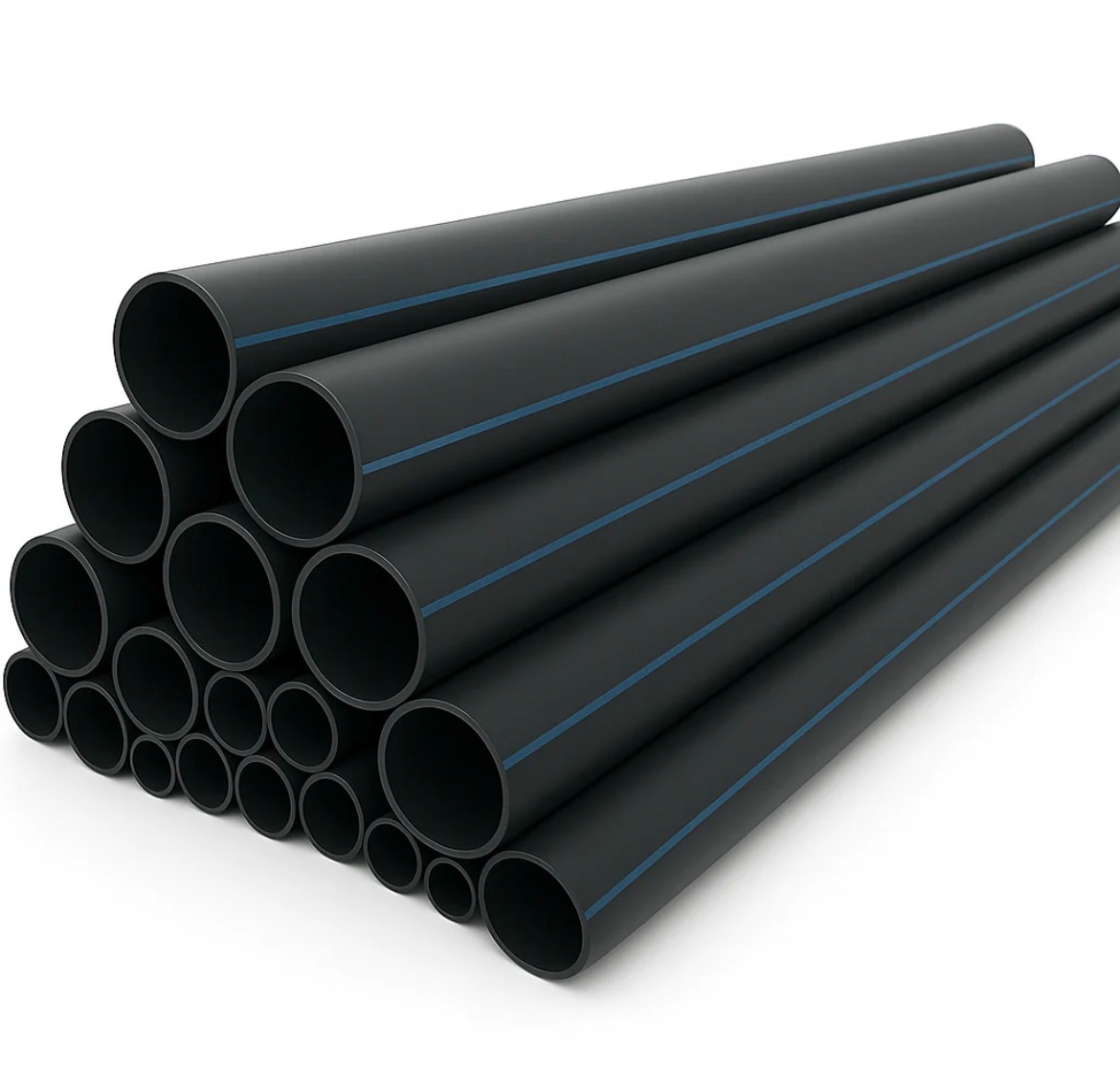 | HDPE Pipe Manufacturing Our HDPE pipes are manufactured using advanced, state-of-the-art technology to ensure superior strength, flexibility, and long-lasting performance. View product → |
Frequently asked questions
Which raw materials are used to make agricultural pipes?
Manufacturers use polyethylene resin, mainly HDPE for pressure lines and LDPE for flexible agricultural pipes and drip products. The selected grade must meet the required density and melt-flow range.
How does extrusion turn resin into an agricultural pipe?
Clean, dry resin is heated and pushed through a die. The formed tube passes through sizing and cooling equipment before manufacturers control its dimensions, cut or coil it, and mark it for traceability.
How is dripline different from plain agricultural pipe?
Dripline includes built-in emitters that release measured water at set spacing and flow rates. Plain pipe transfers water and needs separate outlets, valves, or fittings to distribute it.
What do manufacturers test before supplying agricultural pipe?
They check outside diameter, wall thickness, pressure performance, flow rate where emitters are built in, appearance, marking, batch identification, and production records.
How do you match agricultural pipe to a farm installation?
Compare the pipe's pressure rating and diameter with pump pressure, flow demand, run length, elevation changes, fittings, filtration, soil conditions, and the planned irrigation layout.
Keywords