A new fiber route can fail before the cable is installed if the duct bore, wall structure, joining method and burial conditions do not match the cable and construction method. By the end, you will be able to compare PLB, smooth-wall HDPE, DWC, innerduct and subduct systems, then write a supplier specification that protects installation performance and future capacity.
Key takeaways
- Choose ducts for blowing, pulling, direct burial or crossings.
- Reserve spare bores before finalising the fiber cable plan.
- Specify crush resistance, bend limits, joining and traceability.
- Compare usable delivered length, not just the quoted coil length.
Choose the duct system by installation method, not by product name
The installation method decides the duct system. A duct for cable blowing through a continuous trench route is not automatically suitable for a road crossing, direct burial, or a pull through an existing conduit.
| Option | Installation method | Why it fits |
|---|---|---|
| PLB duct | Cable blown or pulled through a buried telecom route | Permanently lubricated inner surface reduces friction, but you still need the cable’s pulling-tension limit and route bend radius. |
| Smooth-wall HDPE duct | Long pulls, trenchless installation, or cable placement by pulling or blowing | Low internal friction and flexible coils support continuous runs with fewer joints. |
| DWC duct | Direct burial where external protection and impact resistance matter | Corrugated outer walls resist ground loading; confirm that the inner profile suits the cable installation method. |
| Conduit or subduct | New cable placed inside an existing pipe or a concrete-encased crossing | Select the bore, wall structure and bend radius for the available space, pulling load and protection level. |
Ask plastic pipe manufacturers for fiber networks in Pune to classify the quotation as direct-buried duct, duct inside conduit, road-crossing duct, or concrete-encased duct. Do not accept a nominal outside diameter as proof of suitability: request internal diameter, wall thickness, ovality, minimum bend radius, crush resistance, and pulling or blowing requirements.
A hydrostatic certificate for HDPE water pipe does not prove performance as a telecom duct. Request the duct-specific evidence instead.
- Use PLB for lubricated cable installation.
- Use smooth-wall HDPE for long, low-joint routes.
- Use DWC where burial loads demand added external protection.
- Use conduit or subduct where an outer protective system already exists.
Size the bore, spare capacity and bends around the cable plan
Start with the cable’s finished outside diameter, not the duct’s nominal outside diameter. Record the cable type, maximum diameter, minimum bend radius, installation method, and whether future cables will share the route.
1. Set the working bore from the cable plan. Compare the cable diameter with the duct’s guaranteed internal diameter, including its ovality tolerance. For cable blowing, request limits for bore roughness, weld beads, contamination, and internal lubrication; a nominal outside diameter cannot prove usable clearance.
2. Add spare capacity deliberately. A single cable route may need a larger bore for a second cable, while several microducts may require a multi-duct bundle, innerduct, or subduct arrangement instead. Draw the planned occupancy and reserve each future pathway before selecting single-duct or multi-duct construction.
3. Map every bend, chamber entry, joint and crossing on the route drawing. Check the duct’s minimum bend radius against the cable’s minimum bend radius, then use the tighter limit; forcing either around a sharper bend increases pulling tension, friction and cable damage risk.
4. Confirm the installation calculation with the supplier. Give the cable diameter, pulling or blowing method, route length, bend count, chamber spacing and allowable pulling tension, and request the recommended internal diameter and configuration in writing.
For a fiber network duct supply, state whether the quoted length is net usable length or gross coil length. Also specify internal diameter, wall thickness, ovality, end protection and spare ducts, so the ordered configuration matches the cable schedule rather than a catalogue label.
Write a manufacturer specification that proves the duct will perform
Specify acceptance limits, not just “HDPE duct, 110 mm.” Ask for internal diameter, outside diameter, wall thickness, ovality, minimum bend radius, coil length, and straight end length. A nominal outside diameter does not prove that your cable will fit or install successfully.
Request these items from plastic pipe manufacturers in Maharashtra:
- Material grade, virgin or reprocessed resin content, carbon-black percentage, UV stabiliser, density, and melt-flow rate.
- Separate pulling and blowing limits, including maximum tensile load, allowable sidewall pressure, coefficient of friction, draw-rope specification, and recommended lubricant.
- Test results for dimensional inspection, ovality, crush resistance, impact resistance, bend radius, inner-surface condition, and low-temperature performance.
- Lot number, production date, resin certificate, calibration records, test certificates linked to that lot, installation instructions, warranty, and replacement terms for damaged coils.
Compare the evidence by duct construction, because PLB, smooth-wall HDPE and DWC ducts do not carry the same installation risks.
| Duct type | Evidence to demand | Failure exposed |
|---|---|---|
| PLB | Pulling or blowing test, friction result, smooth bore measurement | Cable jams or exceeds tensile limit |
| Smooth-wall HDPE | Crush, impact, ovality and bend tests | Bore collapses after burial |
| DWC | Ring-stiffness and impact tests, plus inner-wall inspection | Corrugation resists burial load but damages installation |
Specify the test method and pass value in the purchase order. A water-pipe hydrostatic certificate proves neither fiber-cable blowing performance nor crush resistance.
Match duct construction to burial, crossings and chamber details
A road crossing cannot use the same duct detail as a lightly loaded verge. The civil and duct installation drawings must show the route condition, design cover, trench width, bedding, backfill material and compaction requirement before anyone orders duct.
Define each construction condition separately:
- Direct burial: state minimum cover, trench base, selected surround, warning tape, marker posts and the traffic or ground load the duct must withstand.
- Duct inside a larger conduit: specify the carrier conduit’s inside diameter, entry and exit points, draw rope, annular clearance, pulling tension and allowable bend radius.
- Road or rail crossing: show casing or protective slab details, crossing depth, sleeve sealing, chamber locations and the method for installing or replacing the duct without damaging it.
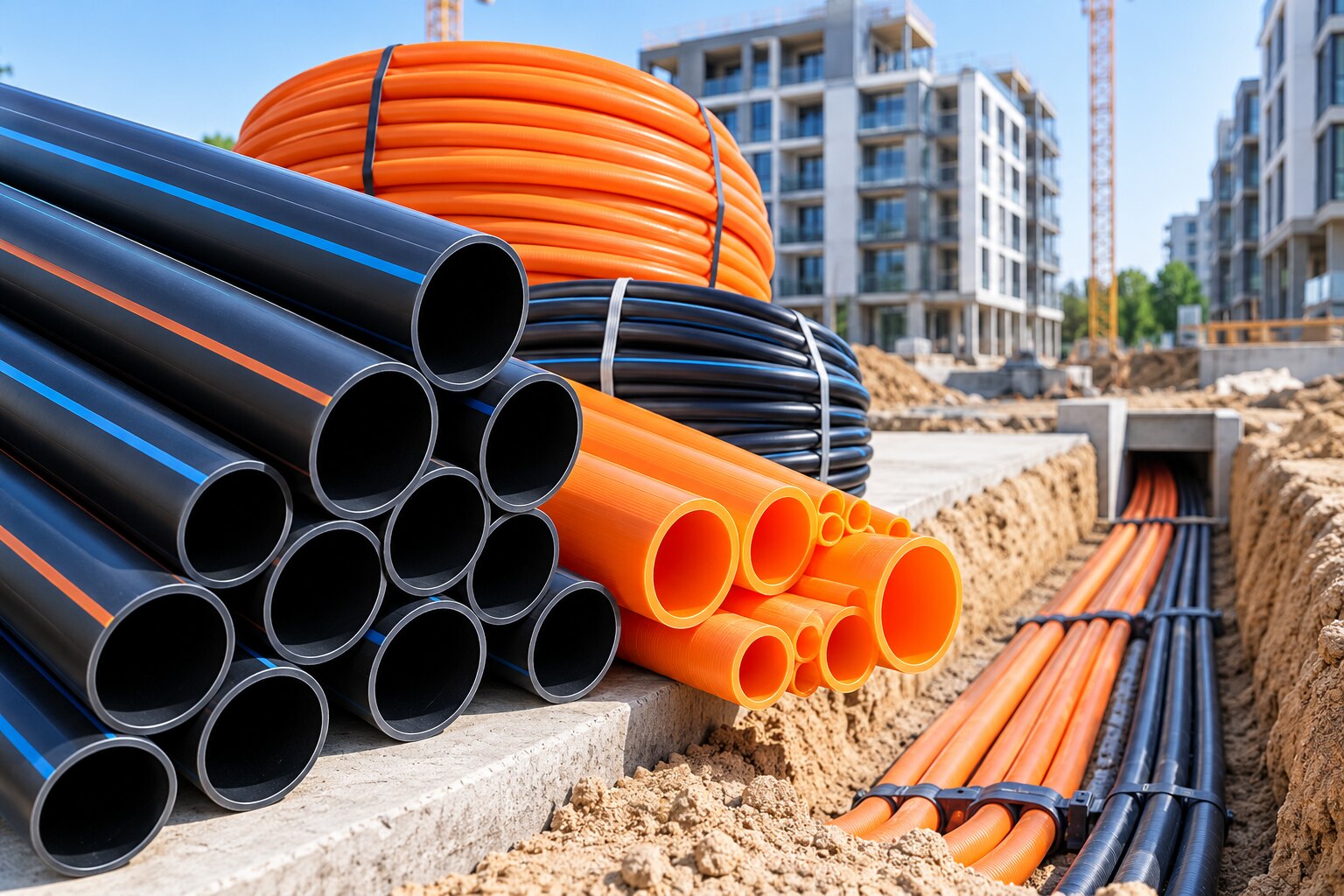
- Concrete encasement: state concrete grade, envelope dimensions, reinforcement, separation between ducts, expansion details and protection at chamber entries.
For every alignment, show horizontal and vertical bends with their radius, not merely a centreline. Mark changes in cover, utility crossings, trenchless launch and reception pits, and minimum separation from water, gas and electrical services.
Chamber drawings must define duct spacing, entry angle, bell-mouth or bush protection, capped spare ducts, draw-rope continuity, drainage and the bend length available for cable storage. PLB lubrication reduces pulling friction; it does not replace a specified cable pulling tension or route geometry.
When comparing plb duct manufacturers in pune, require crush and impact performance for each installation condition, rather than accepting a water-pipe hydrostatic certificate.
Compare suppliers on traceability, joining and usable delivered length
Compare quotations by traceability, joining, and usable delivered length—not price alone. Ask each supplier to prove what arrives, how production lots are identified, and how damaged coils are replaced.
- Require the batch number, resin grade, production date, test certificate, and dispatch record on every lot. Link certificates to the actual coil or drum, not only to a product family.
- State net usable metres, not gross coil length. Include tolerances for length, internal and outside diameter, wall thickness, ovality, colour, markings, end-cap protection, and minimum straight lengths at coil ends.
- Name the approved joining method. Butt fusion or electrofusion depends on resin grade, wall thickness, preparation, temperature, alignment, and fusion settings; request compatible fittings and written parameters.
- Price couplers, end seals, transport, inspection, and jointing labour separately. Short coils and crushed ends can erase a low metre rate.
| Criterion | Strong quotation | Warning sign |
|---|---|---|
| Traceability | Coil number links to batch, resin, tests, and dispatch record | “Quality tested” without lot records |
| Delivered length | Net usable metres, coil tolerances, and replacement terms | Gross length with no damaged-coil policy |
| Joining | Approved method, fittings, and fusion parameters | “All polyethylene is weldable” |
| Performance evidence | Duct-specific pulling, blowing, crush, and ovality results | Water-pipe hydrostatic certificate only |
Shortlist plastic pipe manufacturers in Maharashtra on delivery consistency as well as price. Ask Harsh Agro Pipes And Fittings for the same evidence, then compare every supplier against one identical schedule.
Related product
 | PLB Duct Manufacturing Our PLB ducts are UV resistant and weatherproof, making them perfect for protecting optical fiber cables in telecom infrastructure. View product → |
Frequently asked questions
How should you choose a duct system for a fiber network?
Choose it according to the installation method: cable blowing, pulling through an existing conduit, direct burial, road crossing or another defined route condition.
How do you size fiber duct bores and spare capacity?
Base the bore on the cable diameter, installation method, bend layout and future cables. Add spare ducts or bores before construction fixes the route.
What should a fiber duct manufacturer specification include?
Specify duct material, dimensions, pressure or crush performance, bend limits, joining method, markings, batch traceability and test documents.
What should you compare when selecting duct suppliers?
Compare construction for burial and crossings, chamber compatibility, joining quality, batch records, coil length and the usable length delivered to site.
Keywords